Friday, Jan 23, 2026 | 03 Shaban 1447

Friday, Jan 23, 2026 | 03 Shaban 1447
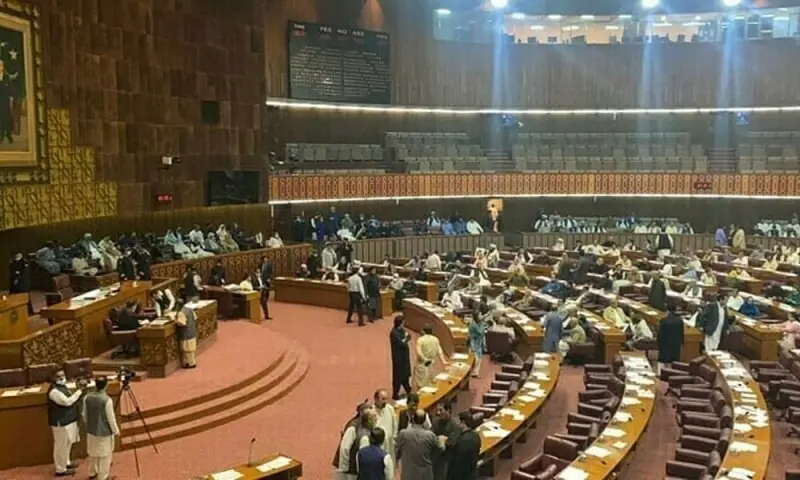
ISLAMABAD: The National Assembly Thursday, passed “The Income Tax Ordinance (Third Amendment) Bill, 2026” to strengthen the Alternative Dispute Resolution (ADR) mechanism for resolving tax disputes and to revise the appointment process for the ADR committee chairperson.
Minister of State for Finance Bilal Azhar Kayani tabled the bill for passage. The House passed the bill by majority vote.
Under the amended law, the appointment process for the chairperson of the ADR Committee has been revised to promote impartiality and transparency.
During deliberations on the Bill in the House, the Minister said that the legislation aims to address gaps in the existing framework, particularly concerning the appointment of the ADR Committee Chairperson.
READ MORE: Income Tax Ordinance (Third Amendment) Bill 2025: NA body directs ministry to revise key provisions
He explained that the measure is intended to safeguard impartiality, improve operational efficiency, and ease the burden on the courts, thereby strengthening ADR as a credible, accessible, and cost-effective option for taxpayers.
He said, “under the new law, both taxpayers and the Federal Board of Revenue (FBR) will propose three names each for the chairmanship. If consensus fails, one nominee from each side will be forwarded to the Law Minister for final decision.
The Chairperson must be a retired judge of the High Court, Federal Constitutional Court, or Supreme Court with relevant tax or commercial experience.”
The Minister said that previously the FBR held exclusive authority to appoint the chairman, raising concerns about impartiality. The revised process, he said, strengthens taxpayer protections, enhances the ADR framework, and ensures fair dispute resolution.
According to clause (3) of the bill, “the Chairman of the Board, after examination of the application of an aggrieved person, appoint a committee, within fifteen days of receipt of such application by the Board, comprising, —
(a) a retired judge of a High Court, the Federal Constitutional Court or the Supreme Court having adequate experience in dealing with tax or commercial matters, who shall also be the Chairperson of the Committee, to be nominated by the Chairman of the Board from a panel of three names proposed by the nominee of the taxpayer under clause (c) of this sub-section.In case the Chairman disagrees with the names proposed by the persons nominated by the taxpayer in terms of clause (c), the Chairman of the Board shall require the nominees appointed under clause (b) and (c) to propose one name each of a retired judge of a High Court, the Federal Constitutional Court or the Supreme Court having adequate experience in dealing with tax or commercial matters, whereupon the Chairman shall forward such names to the Federal Minister for Law and Justice for nomination of one of such persons as Chairperson of the Committee; (b) an officer of the Inland Revenue not below BS-21, other than the Chief Commissioner Inland Revenue having jurisdiction over the case; and (c) a person to be nominated by the taxpayer from amongst — (i) accountants within the meaning of the Chartered Accountants Ordinance, 1961 or(ii) cost and management accountants within the meaning of the Cost and Management Accountants Act, 1966; or (iii)advocates having a minimum of fifteen years’ experience in the field of taxation or commercial matters; or (iv)officers of the Inland Revenue who retired in BS-21 or above; or (v)businessmen from a list notified by the Board as recommended by the Federation of Pakistan Chambers of Commerce and Industry: Provided that the taxpayer shall not nominate a chartered accountant or an advocate if the said chartered accountant or the advocate is or has been an auditor or an authorized representative of the taxpayer.”
According to the objects and reasons of the bill, “the bill aims to ensure impartiality and enhance efficiency in the ADR process, besides reducing litigation burden on courts. More aptly, the purpose of the bill is to make ADR a viable option for cost-effective resolution of tax disputes.”
Six bills, ‘The National Anti-Money Laundering and Counter Financing of Terrorism Authority (Amendment) Bill, 2026, The National Archives (Amendment) Bill,2026, The Abandoned Properties (Management) (Amendment) Bill, 2026, The Naya Pakistan Housing and Development Authority (Amendment) Bill, 2026, The Oil and Gas Regulatory Authority (Amendment) Bill, 2026 and The Electronic Transactions (Amendment) Bill, 2026, were introduced in the National Assembly.
The Speaker referred the bills relevant standing committees of the House for further deliberation.
Copyright Business Recorder, 2026