Thursday, Jan 01, 2026 | 11 Rajab 1447

Thursday, Jan 01, 2026 | 11 Rajab 1447
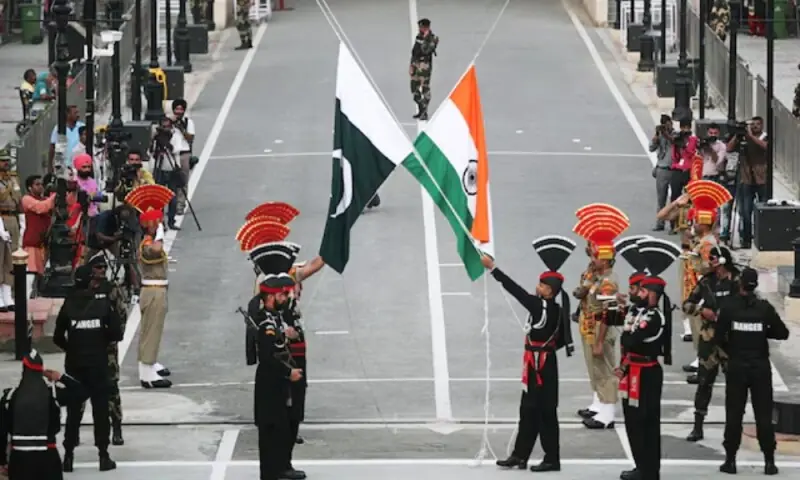
Pakistan and India on Thursday exchanged list of nuclear installations under the Agreement on Prohibition of Attacks against Nuclear Installations and Facilities.
Pakistani and Indian foreign affairs ministries confirmed the development in separate statements.
Pakistan and India exchanged the lists of their respective nuclear installations and facilities, today, the FO said in a statement. The exchange took place pursuant to the Agreement on Prohibition of Attacks against Nuclear Installations and Facilities between Pakistan and India.
“Accordingly, the list of nuclear installations and facilities in Pakistan was officially handed over to a representative of the Indian High Commission in Islamabad at the Ministry of Foreign Affairs,” read the statement.
Simultaneously, the Indian Ministry of External Affairs handed over the list of India’s nuclear installations and facilities to a representative of the Pakistan High Commission in New Delhi.
The Agreement on Prohibition of Attacks against Nuclear Installations and Facilities between Pakistan and India, provides that both countries shall inform each other of their nuclear installations and facilities, falling within its definition, on 1st January of each calendar year. The agreement was signed on December 31, 1988, and entered into force on January 27, 1991. Both countries are exchanging the lists since January 1, 1992.
During the weekly briefing, Foreign Office Spokesperson and Additional Foreign Secretary for Arms Control, Disarmament & International Security (ACDIS) Tahir Andrabi on Thursday said at the start of the New Year, Pakistan and India formally exchanged lists of prisoners as well.
READ MORE: India’s weaponisation of water to inflame tensions in already hostile ties: Sherry Rehman
According to Andrabi, a list of 257 Indian prisoners currently in Pakistan was handed over to India. He added that this exchange takes place twice a year, on January 1 and July 1, under the 2008 Agreement on Consular Access. Similarly, lists of nuclear installations are also exchanged annually on January 1, he added.
“A list of nuclear installations and facilities in Pakistan was officially handed over to the representative of the Indian High Commission in the Foreign Office today. I understand that the Indian government is also sharing the list of Indian nuclear installations with our high commission in New Delhi,” he said.
Commenting on the violence in Yemen, the FO spokesperson stated that Islamabad supports a peaceful resolution to the Yemen conflict and welcomes ongoing diplomatic efforts for regional stability.
The spokesperson mentioned that Pakistan considers regional efforts to normalise the situation as vital and desires a solution through dialogue between all parties.
The spokesperson noted that Prime Minister Shehbaz Sharif and Saudi Arabian Crown Prince Mohammad bin Salman recently held a telephonic conversation, reaffirming their commitment to further strengthening bilateral relations and cooperation. Regional issues were also discussed during the phone call, he added.
Andrabi said Foreign Minister Ishaq Dar also contacted his Saudi Arabian counterpart to discuss matters of mutual interest.
The FO further shared that the president of the United Arab Emirates recently paid an official visit to Pakistan, during which talks were held on enhancing bilateral ties and cooperation in various sectors. The spokesperson stated that Pakistan considers strengthening relations with brotherly Islamic countries a cornerstone of its foreign policy.
Regarding a question about the photograph showing National Assembly Speaker Ayaz Sadiq shaking hands with an Indian leader in Dhaka, Andrabi said he had seen the picture and noted that the NA speaker himself had already provided a clarification on a TV channel. The spokesperson stated he could neither add to nor subtract from that statement.
READ MORE: NA Speaker meets India’s Jaishankar on sidelines of Khaleda Zia’s funeral in Dhaka
Reiterating Pakistan’s stance on China, the spokesperson said Pakistan fully supports China on all its core and sensitive issues, including Taiwan. He added that in the context of current regional circumstances, activities and measures that lead to increased tensions should be avoided.
In response to questions regarding India, the spokesperson mentioned that reports concerning the Dulhasti State Project have been noted, and Pakistan is keeping a close watch on the matter. He said Pakistan demands full implementation of the Indus Waters Treaty by India. According to the spokesperson, the Pakistani Indus Water Commissioner has sent several queries to his Indian counterpart, and Pakistan awaits timely and satisfactory responses.
Discussing Afghanistan, the spokesperson described the fatwa issued by Afghan scholars and recent statements by the Afghan leadership as positive developments; however, Pakistan is still awaiting practical guarantees from Afghanistan. He emphasised that Afghan soil must not be used against Pakistan under any circumstances.
The spokesperson revealed that a humanitarian aid convoy was sent by Pakistan to Afghanistan, but Afghan authorities stopped the convoy, which had been announced by the prime minister. He stated that Pakistan will continue to play its role under global laws and international obligations, and providing aid on humanitarian grounds is part of this policy.
The Foreign Office spokesperson emphasised that the Ministry of Foreign Affairs is performing its duties with complete independence and that the primary objective of Pakistan’s foreign policy is regional peace, mutual respect, and adherence to international law. He said Pakistan believes in resolving issues through dialogue and diplomacy with all relevant parties.