Monday, Feb 09, 2026 | 20 Shaban 1447

Monday, Feb 09, 2026 | 20 Shaban 1447
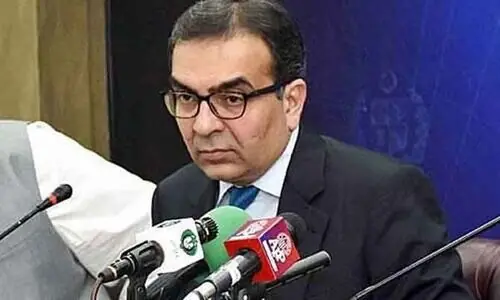
Advisor to Prime Minister on Privatisation and Chairman of the Privatisation Commission (PC) Muhammad Ali said on Saturday Pakistan needs to improve its manufacturing and export if it wants to put its economy on a growth path.
Speaking at a panel discussion on ‘Fixing the Fundamentals: Pakistan’s Economic Reset’ at the 17th Karachi Literature Festival (KLF), he said influential sectors and entities like APTMA (All Pakistan Textile Mills Association) and automobiles got their works done through the power corridors.
“Multinational companies (MNCs) are leaving the country. Salaried class people are bearing the burden of high tax rates. Consumers are paying over Rs40/per unit for the electricity that is being produced at a cost of Rs10/ per unit due to too much involvement of the government in the energy and many other sectors, which is not its job,” he said.
Also read: Successful PIA privatisation sends strong signal to global investors: Aurangzeb
Ali said Pakistan had to do four to five major reforms in the current political and economic setups to address the chronological issues and fix fundamentals, and to begin the nation’s journey towards growth and prosperity - including reducing the role of the government in businesses to empower businesses to let them take swift and prudent decisions on time.
He further suggested documenting the informal economy and incorporating it into the formal economy to block corruption and control tax leakages, as all the required data was available.
To improve governance nationwide, he urged to create more provinces and cities and revive the local governments (LG) setup with providing all the required resources till the grace root level.
He said the centralized decision-making is weakening the governance, arguing the decentralized decisions-making would support turnaround including in the economy.
Ali stressed to have industrial and export plans and integrate women - almost half of the population - in the workforce of the country for an increased economic output.
“We have to move towards a market-based economy where demand and supply would determine the product price and quality.”
The PC chairman said documentation of the informal economy was not impossible.
In Pakistan, there are about 40 million power consumers, 10 million gas consumers, and 180 million mobile subscribers. Computerised National Identity Cards (CNICs) are issued to all of them.
“So, how difficult can it be to document the economy? We have all the data. We have all the people. If there are 40 million power consumers and the unit [family] size is five-people, we can access the data of 200 million people.
“Once we document the economy, a lot of problems will get solved. After that the tax base may widen and the tax rates could go down. The documentation can help resolve taxation and fiscal burden.”
According to Ali, Pakistan needs to identify three, four or five industries to be focused on and work upon them for the next five years, 10 years or for 20 years to revive industrialisation and revive exports.
“At this point in time, the biggest cause of the existing issues is that the size of the governance unit is so large.
“We have provinces with 100 million people and 50 million people. The size of cities is so big. I think we need to reduce the size along with the money that goes through NFC (National Finance Commission)…provinces should go vertically till the grace root level. At the same time, we need to empower the local governments and give them the resources. The centralised decision-making is weakening the governance.“
After the successful privatisation of Pakistan International Airlines (PIA), the government was determined to sell-off power distribution companies in the private sector and do energy reforms. “The moves are aimed at reducing the power price,” he said.
Meanwhile, former Finance minister Miftah Ismail presented 10 points to reset the economy including those discussed by PC chairman Ali. He maintained that terrorism, particularly the one led by TTP (Tehrik-i-Taliban Pakistan), remained the number one challenge.
The rising poverty was partially contributing towards that, he added.
Ismail proposed to ensure education for all children and control the birth rate.
Provinces needed to generate resources instead fully depending on NFC and cut government expenditures, he proposed.
“Some 20-30% funds go into corruption out of funds allocated for development projects at federal and provincial levels.”
He said the Constitution did not provide structure to support growth after having 27 amendments. “So, if you don’t like the Constitution, change it, or do what is written there in the Constitution.”
Another former Finance minister Asad Umar questioned how could Pakistan’s exports grow when they did not produce what the world markets demanded for.
The country was still relying on outdated products to grow exports like bedsheets, undershirts, and socks, he added.
“Pakistan produces not a single product out of the top 12 goods that China imports from the world.”
State Bank of Pakistan’s (SBP) former governor Dr Ishrat Hussain stressed upon reviving agriculture sectors that could attract exports worth around $10 billion a year and help turn the current account into a surplus of $6-7 billion a year.
“Invest in small investors. There is too much potential to increase their per acre yield compared to what big farmers and farmers around the world realise.”
Pakistan Business Council (PBC) chairperson Zeelaf Munir said Pakistan’s economic growth had remained low over the past 30 year.
“We are lying behind peer countries. If we had grown parallel with regional countries, our per capita income would have been 40% better compared to the current one.”
Moderator of the panel Muhammad Azfar Ahsan said education was the key towards all the success.
He agreed with speakers to reinstate the local governments system and reduce the role of the government in businesses.